

You already know you need to automate business processes and introduce AI. You have read the articles. You have seen what competitors are doing. You might even have a shortlist of tools you have been meaning to explore.
And yet – nothing has happened. Not because you do not believe in it, but because every time you sit down to figure out where to actually start, the picture gets blurry. Should you automate sales first, or fix reporting? Buy a new platform, or connect the ones you have? Hire someone, or outsource?
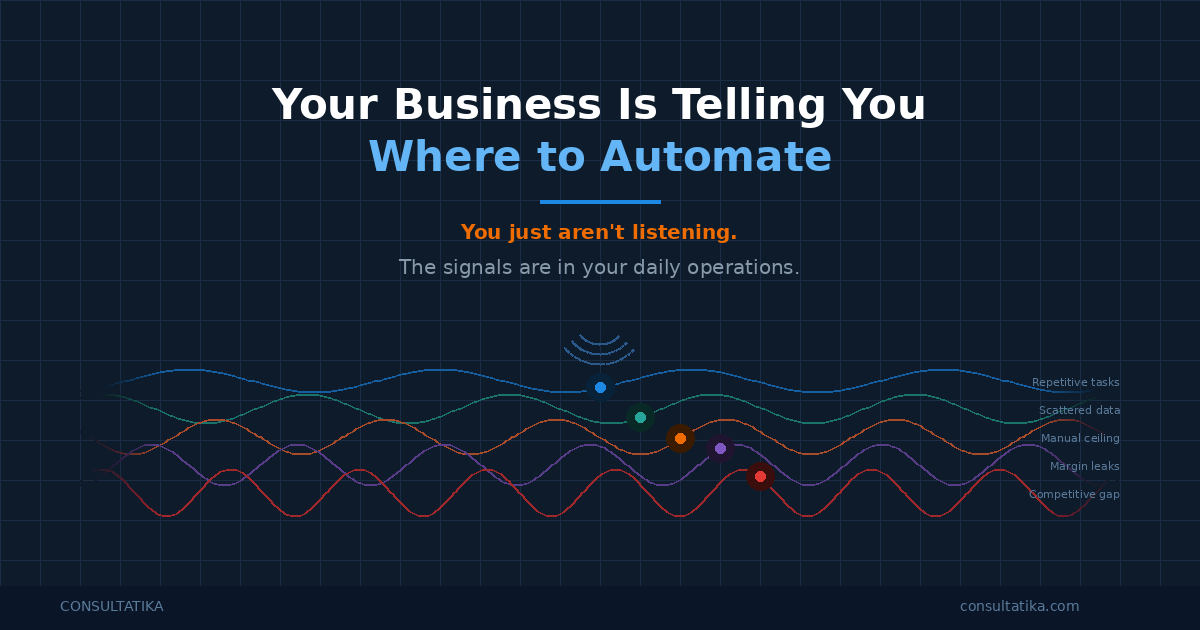
Here is the thing most SME owners miss: your business is already answering that question. Every day, through the frustrations your team voices, the workarounds they have built, and the margin you cannot explain – your operations are pointing directly at the starting line. You just need to know how to read the signals.
Signal: “We spend half our morning just updating the tracker”
Every company has these. Data gets copied from one system to another. The same report gets rebuilt every Monday. Follow-up emails go out manually because nobody set up the automation yet.
Your team probably mentions it in passing: “I spend half my morning just updating the tracker.” They are not complaining – they are showing you the starting point.
Where to look: Ask your team one question this week: “What task do you repeat every day that follows the exact same steps?” The answers will point you directly to your first automation win – the one that frees up real hours with minimal risk.
Example: A logistics company where dispatchers spent 2 hours every morning manually assigning routes using the same criteria. The process had not changed in years – everyone knew it could be automated, nobody knew who should do it or how.
Signal: “How did we do last month?” takes days to answer
CRM knows about clients. ERP knows about orders. Spreadsheets know about margins. Your inbox knows about problems. But nothing talks to anything else.
So when someone asks “how did we do last month?” – the answer takes days, not minutes. And by the time you have the numbers, you are already making next month’s decisions on instinct.
You do not need to replace these systems. You need to connect them. That is often the fastest, lowest-risk first step – and it unlocks everything that follows, including AI.
Where to look: Map which systems your team opens during a typical day. If the answer is more than three, and they are manually transferring information between them, you have found your integration starting point.
Example: A food manufacturer whose sales team promised delivery dates from memory because checking real-time inventory meant opening three systems and cross-referencing manually. The data existed – it just was not connected.
Signal: Your best spreadsheet still takes 4 hours to consolidate
Better spreadsheets. Longer SOPs. A project coordinator hired specifically to “keep things organized.” You have done what you can – and things are better than they were. But you have hit the wall.
Reports still take too long. Errors still happen at handoff points. Key information still depends on one person remembering to update something. Manual optimization has a ceiling, and you have reached it.
This is actually the best place to automate business processes. The process is already understood. The logic is clear. You have already done the hard work of figuring out what should happen – you just need to stop doing it by hand.
Where to look: Find the process your team has optimized the most manually. That is usually the one with the most elaborate spreadsheet, the most SOPs, the most workarounds layered on top of each other. That complexity is a sign that the process matters and is well-understood – which makes it the ideal automation candidate.
Example: A consulting firm built an elaborate project tracking spreadsheet with macros and conditional formatting. It still took the operations manager 4 hours every Friday to consolidate it into a weekly status report for leadership.
Signal: Margin is shrinking and every department has a different theory
Revenue is fine. Costs seem reasonable. But profit keeps getting thinner, and every department has a different theory about why.
This is not a cost-cutting problem. It is a visibility problem. When reporting is fragmented and slow, small inefficiencies compound invisibly: unneeded overtime, wasted materials, lost customers, pricing leaks.
AI is exceptionally good at finding these patterns in your existing data – but only if the data is accessible. The starting point is not an AI tool. It is getting your operational data into a shape where patterns can actually be detected.
Where to look: Ask yourself: “If I wanted to know exactly where we lost margin last quarter, how long would it take to get that answer?” If the answer is more than a few hours, you have a visibility gap that is costing you real money every month.
Example: A plastics packaging manufacturer with healthy revenue growth but declining margins. The CEO suspected raw material costs, sales blamed underpriced contracts, and production pointed to overtime. A structured diagnostic revealed the real issue: inconsistent discount approvals and untracked minimum order exceptions that were silently eroding profitability across dozens of accounts.
Signal: Your competitors respond faster — and you cannot figure out how
This is the one that keeps you up at night. You see competitors responding faster, delivering more consistently, or offering things you cannot match without more headcount. They are not necessarily using cutting-edge AI – they have just automated the basics earlier.
The uncomfortable truth: the longer you wait, the more expensive it becomes to catch up. Not because the technology gets more expensive, but because the operational gap compounds. Every month of manual processes is another month your competitors are pulling ahead.
Where to look: You do not need to match what competitors are doing feature by feature. You need to identify the one operational bottleneck that, if removed, would have the biggest impact on your speed, margin, or capacity. Start there.
Example: An industrial maintenance company whose competitors now accepted and confirmed service requests through automated ticketing systems within minutes, while their own team still took requests by phone, wrote them in a notebook, and re-entered them into the system the next day. They did not need a full digital transformation – they needed one specific intake workflow automated first.
The mistake most SMEs make at this point
You know you need to move. The signs are clear. So the instinct is to start shopping for tools. A new CRM. An AI chatbot. An automation platform someone recommended on LinkedIn.
But here is the problem: without knowing which process to fix first, every tool looks like it could be the answer – and none of them actually are. You end up buying software before understanding the problem, which is how SMEs waste five-figure budgets trying to automate business processes they have not properly diagnosed.
The right first step is not a tool. The right steps are analysis and diagnostics.
Which processes are costing you the most? Where is the margin actually leaking? What should you automate first, and what should you leave alone? These are the questions that need answers before any technology decision makes sense.
Start with clarity, not software
Our free Discovery assessment is built for exactly this moment. It takes a few minutes, requires no call, and gives you a clear, personalized view of where your biggest opportunities are – so you stop guessing and start with the right thing first.
If you want to go deeper, our Tier 2 Diagnostic gives you a full operational roadmap with specific recommendations, delivered within 48 hours with an expert debrief call. Explore Services →