

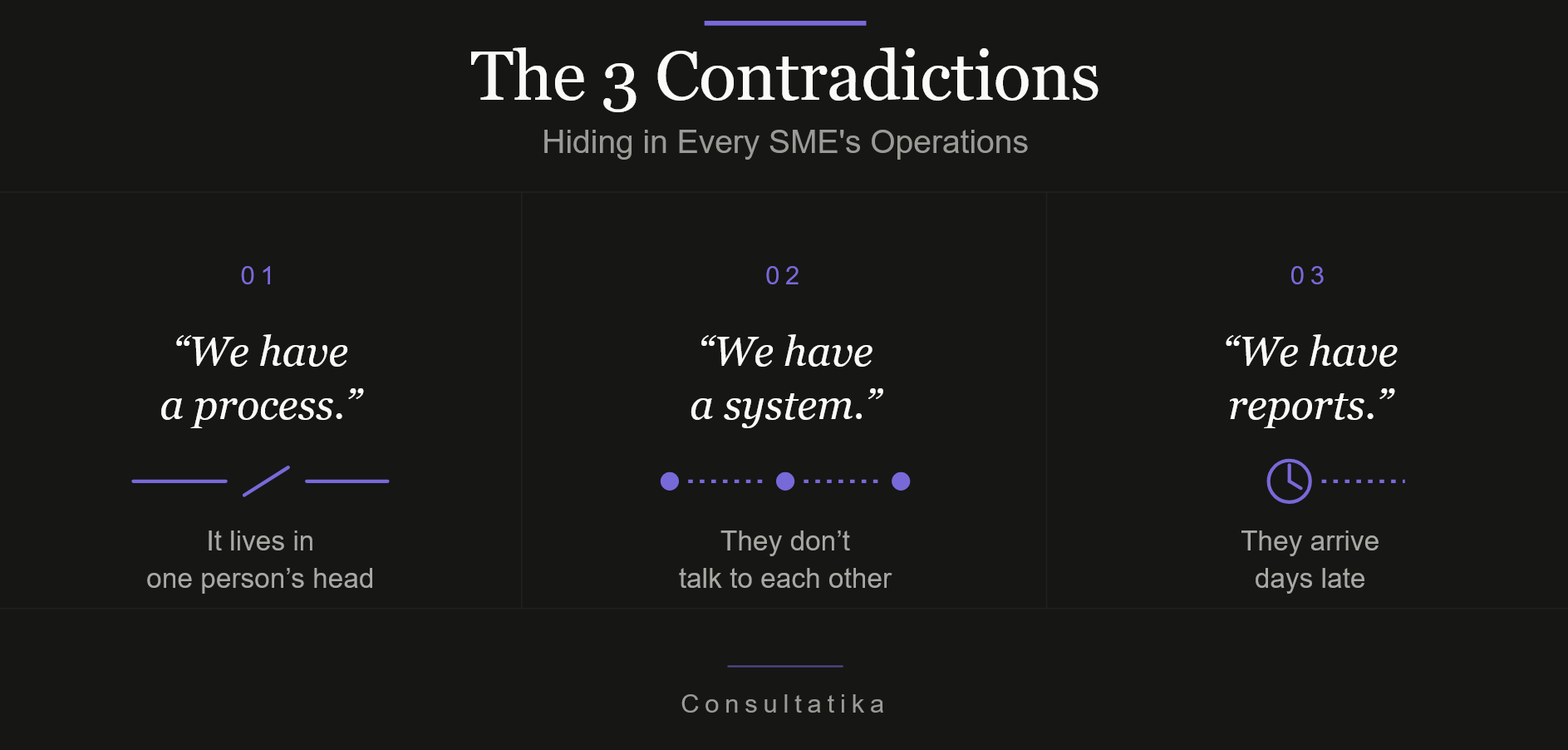
When we walk into an SME and start mapping operations, we don’t usually find one big broken thing. We find three small contradictions. The owner believes one thing about their business – and the daily reality says the opposite.
The contradictions aren’t lies. They’re not bad management. They’re the natural drift between what you set up two years ago and what your team is actually doing today. But until someone names them out loud, they stay invisible.
Here are the three we see almost everywhere.
Contradiction 1: “We have a process”
What you say: We have a standardized way of doing X. Sales follows a process. Operations follows a process. Onboarding follows a process.
What’s actually happening: One or two people in the team are the process. They know the exceptions, the workarounds, the “well, in that case we usually…” rules that never made it into the document. When they’re on vacation, work either stalls or gets done differently – and nobody can quite explain why the quality varies week to week.
Example: A marketing agency with 12 employees has a documented “campaign reporting process.” But when you look closely, each account manager has built their own format, pulls data from different places, and applies slightly different logic. The standard process exists on paper. The actual standard lives in three different heads, in three different versions.
Why it persists: Documenting a process feels like solving it. The document gives the appearance of standardization without the work of actually enforcing it. Nobody is going to audit whether the team follows the document, so the document and the team drift apart.
What it costs: Onboarding new people takes 3-6 weeks longer than it should. Quality varies by who’s working. The owner can’t scale because the business depends on individuals who know the exceptions.
Contradiction 2: “We have a system”
What you say: We use an ERP. We use a CRM. We have an accounting system. Everything is centralized.
What’s actually happening: The systems exist. They just don’t talk to each other. So someone re-types customer data from CRM into ERP. Someone exports ERP data into Excel for finance. Someone manually consolidates spreadsheets from three locations every Monday morning. The systems are technically central – but the people are the integration layer.
Example: A food manufacturer has CRM, ERP, and a warehouse management system. All three work. Sales is in the CRM, inventory in the warehouse system, financials in the ERP. But sales doesn’t see real-time stock, so they promise delivery dates that production can’t meet. Customer complaints, late deliveries, broken trust – all because three systems that should be talking to each other don’t.
Why it persists: Each system was bought to solve a specific problem and did. Nobody owns “the gaps between the systems.” That’s nobody’s job until it’s everybody’s problem.
What it costs: 5-15 hours a week of manual data re-entry across the team. Master data inconsistency (same customer name spelled three ways across three tools). Reports that take days to compile because they require pulling from multiple sources. The cost compounds – it doesn’t sit still.
Contradiction 3: “We have reports”
What you say: We have monthly reports. We have a dashboard. Management sees the numbers.
What’s actually happening: The reports arrive 5-10 days late. They reflect last month, not this month. By the time you see that margin slipped in March, it’s mid-April and you’ve already done another month of the same thing. The reports tell you what already happened, not what’s currently happening – and even then, only after manual rebuilding.
Example: A logistics company with 80 employees generates a monthly management report by manually copying data from three operational systems into Excel. The report is always 5-7 days late and frequently contains errors. The owner makes decisions on data that’s 6 weeks old by the time he’s confident in it.
Why it persists: Faster reporting requires fixing the data layer underneath. Most companies treat reporting as a presentation problem – make the dashboard prettier, add a chart – when it’s actually a plumbing problem. The underlying data is fragmented and slow.
What it costs: Decisions get made on old information. Problems aren’t visible until they’ve already cost money. The team works hard to produce reports that are obsolete the day they’re finished.
Why these three matter
Each contradiction in isolation is annoying. But they reinforce each other.
You can’t standardize a process if the underlying systems require workarounds that only certain people know. You can’t connect the systems if there’s no clear process to map. You can’t get fast reports if neither the processes nor the systems produce clean data.
This is why “fix the reporting” never solves anything by itself. The chaos lives at the layer below.
The diagnostic step most owners skip
Here’s the awkward truth: most SME owners can’t see these contradictions from the inside. Not because they’re not smart. Because they’re too close. They built the company, they hired the team, they bought the systems – every individual decision made sense at the time. The contradictions only emerge when someone external maps the whole picture.
This is exactly what our Tier 1 Discovery surfaces – in 5 minutes, with 14 behavioral questions. We don’t ask “do you have a process?” – everybody says yes. We ask questions that reveal whether the process actually functions. The contradictions show up immediately in the report.
If two or more of these contradictions sound familiar – start here. No call, no commitment, no sales pressure. Just a personalized PDF that names what’s quietly leaking under the surface of your business.